


How DxO’s pioneering approach makes DNG files four times smaller without impacting quality
DxO PureRAW 6 introduces a new high-fidelity compression option for the DNG format, reducing file sizes by approximately 4x compared to the current lossless compression, while preserving full perceptual image quality.
DxO’s new High-Fidelity Compression technology combines two complementary techniques: Dynamic Range Compression and the JPEG XL image codec.
Key benefits
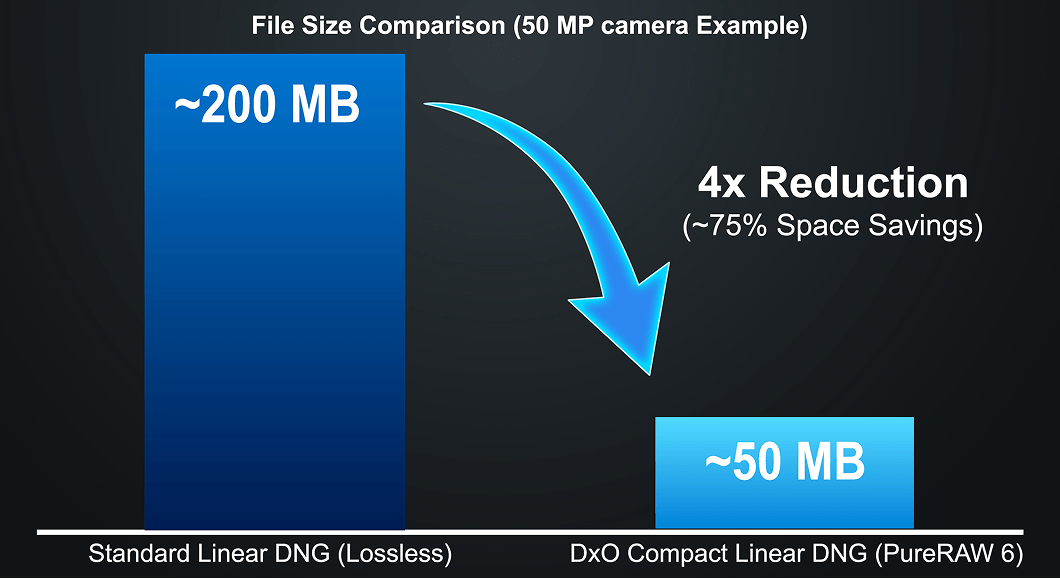
- 4x smaller files — A 50 MP camera's Linear DNG drops from ~200 MB to ~50 MB, making Linear DNG practical for everyday use and high-volume workflows. Smaller files mean faster imports, faster cloud syncs, and less disk usage.
- High fidelity — The compression is perceptually transparent, even under aggressive editing.
- Compatibility — The output remains a standard DNG file. Any DNG-compatible application (Adobe Lightroom, Capture One, etc.) can open and edit these files normally.
Why compress more?
Linear DNG is DxO's recommended output format for DxO PureRAW because it preserves maximum editing latitude while being universally compatible with third-party RAW processors. However, even with the lossless compression built into the DNG specification, a typical Linear DNG weighs in at approximately 4 MB per megapixel. For a 50 MP camera, that is 200 MB per image.
Clearly, there is a strong motivation to compress these files more aggressively.
But how far can we go without compromising quality?
From lossless to perceptually lossless
Lossless compression is the most reassuring approach for both developers and users alike, since it guarantees that the decompressed file is mathematically identical to the original, bit for bit. However, this class of algorithms is inherently limited in efficiency, especially when the signal being compressed contains information that, from a perceptual standpoint, is useless.
For DxO PureRAW
We identified two types of perceptually irrelevant information in Linear DNG files:
1. Excess pixel precision. Digital camera RAW files are typically encoded at 12 or 14 bits per pixel; the output of our DeepPRIME pipeline uses 16 bits. However, images always retain some residual noise, intentionally left in place to prevent the unnatural “plastic” appearance caused by complete denoising. As we explain below, the more noise a signal contains, the less its full numerical precision is relevant. Removing the unused precision is the role of Dynamic Range Compression (DRC).
2. Exact texture and grain shape. In practice, slight differences in the exact shape of noise grain or fine texture are imperceptible. Simplifying these micro-details is a classic principle in image and video compression, and is the domain of the JPEG XL codec.
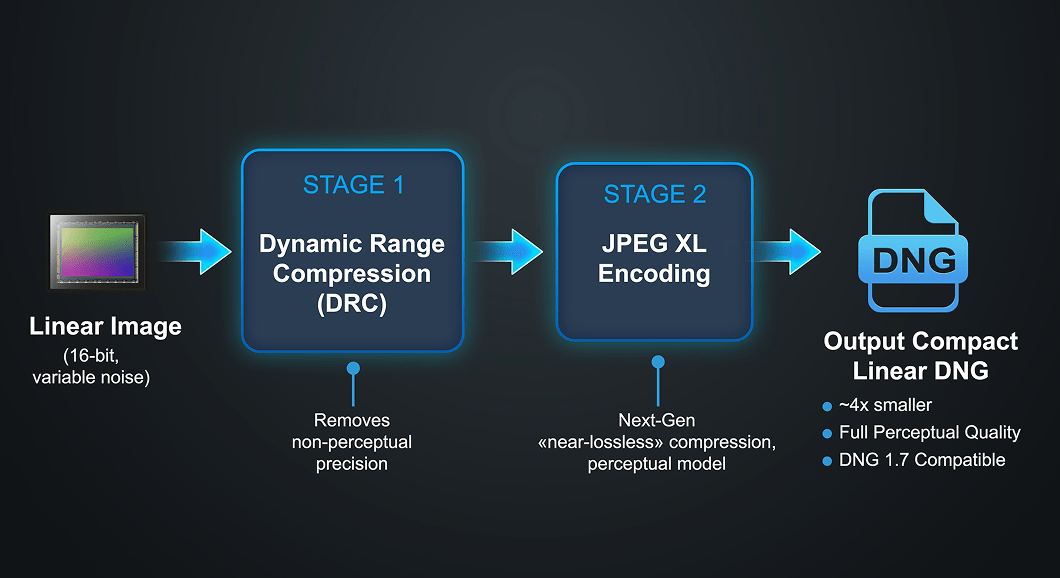
Both techniques require standard DNG mechanisms so that any compatible software can open the resulting files transparently. DRC is encoded via the DNG Linearization Table tag, and JPEG XL is a compression mode introduced in DNG specification version 1.7. Both are supported by common RAW processing applications.
Dynamic Range Compression
Dynamic Range Compression (DRC) is a well-known technique in audio signal processing. A compressor reduces the dynamic range of a signal by applying a non-linear transfer function: in audio terms, loud parts are attenuated, and quiet parts are boosted so that the signal fits more efficiently within a given bit budget. The same principle turns out to be remarkably well-suited to RAW digital images.
Why DRC works for RAW images
Digital images are affected by photonic (shot) noise, a fundamental property of light itself. The standard deviation of this noise grows with the square root of the signal intensity.
This has a profound consequence for compression of linear images:
- In dark regions, noise is very low, and the signal is finely structured. Every bit of precision can carry genuinely useful information — 14 or even 16 bits may be needed.
- In bright regions, noise is comparatively large. The useful signal precision is far lower than what 14 or 16 bits represent. Those extra bits encode noise more precisely than anyone would ever need or could ever see.
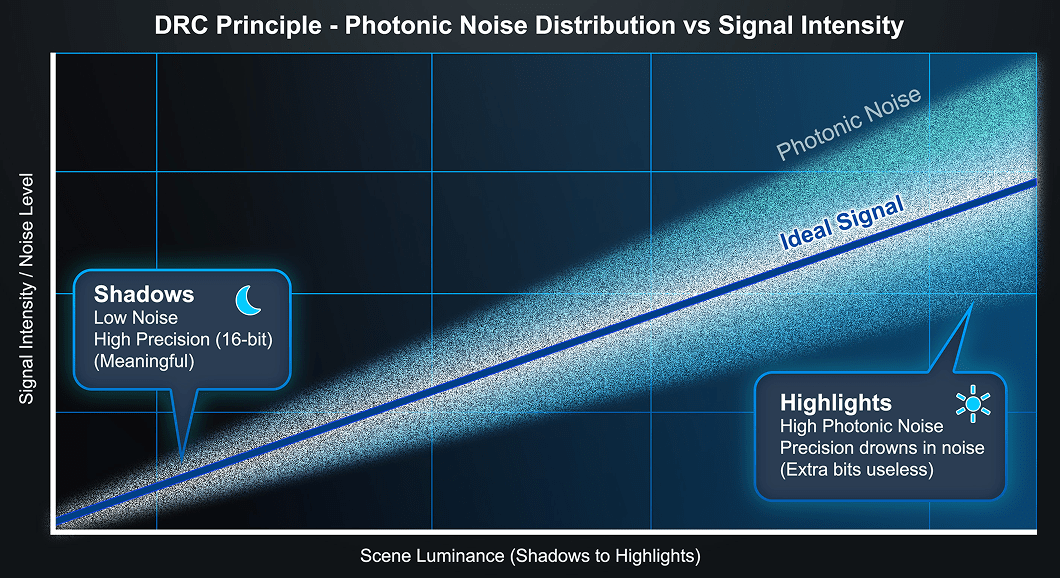
It is precisely these perceptually useless high-precision samples in the highlights that make lossless compression less efficient: the compressor must faithfully encode bits that carry no meaningful information.
- DRC addresses this by applying a companding function — concretely, a curve close to the square root — to the linear pixel values before compression. This is conceptually related to a variance-stabilizing transform: after the square root, the noise standard deviation becomes approximately constant across the entire tonal range. Precision is thereby allocated where it matters — many levels in the shadows, fewer in the highlights — without discarding any information that was perceptually meaningful to begin with.
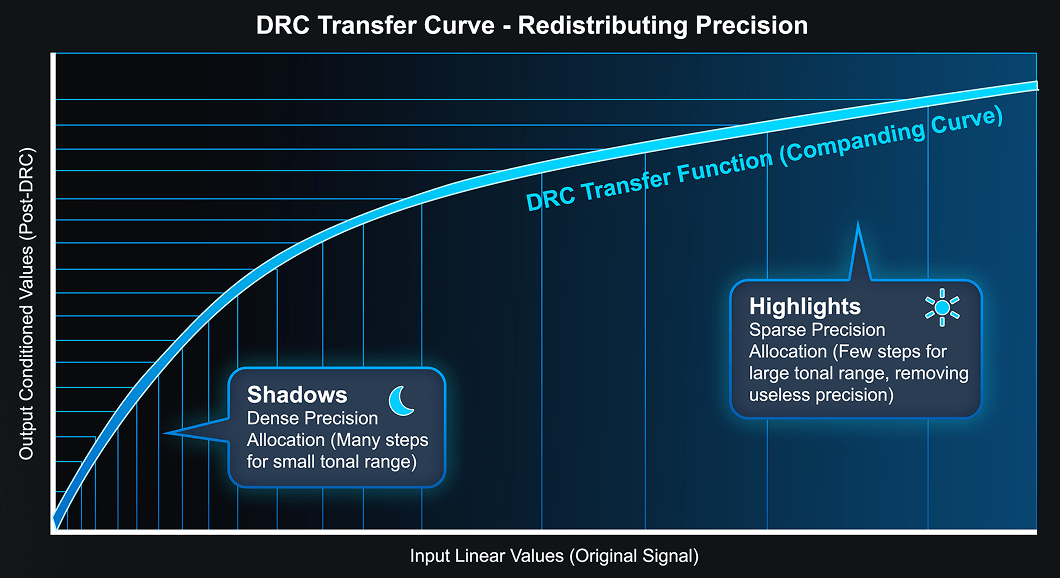
At decompression time, the inverse function (stored in the DNG Linearization Table) restores the original linear encoding, exactly as the DNG specification intends. The process is fully transparent to any downstream application.
The number of quantization levels was chosen conservatively and validated against worst-case editing scenarios such as large exposure pushes combined with extreme shadow recovery to ensure that quantization artifacts remain invisible in all practical uses.
JPEG XL compression
After DRC, the conditioned image is compressed using JPEG XL, the next-generation image codec standardized by the JPEG committee.
What makes JPEG XL better than legacy JPEG?
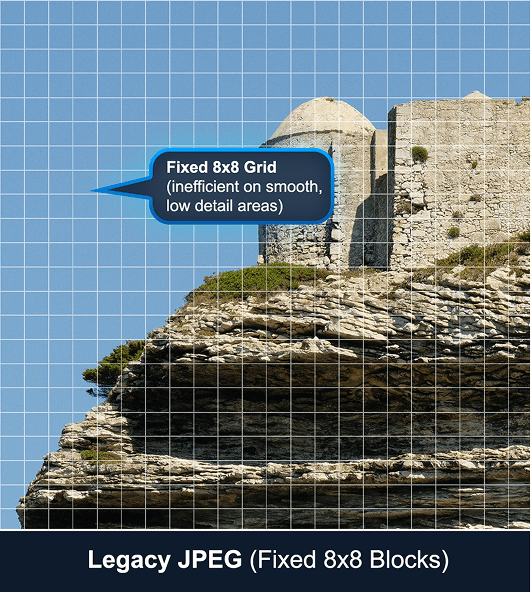
Legacy JPEG dates from 1992 and relies on a fixed 8x8 block transform with relatively simple entropy coding. While groundbreaking in its time, this approach leaves significant compression performance on the table by today's standards. JPEG XL incorporates over two decades of advances in image compression research:
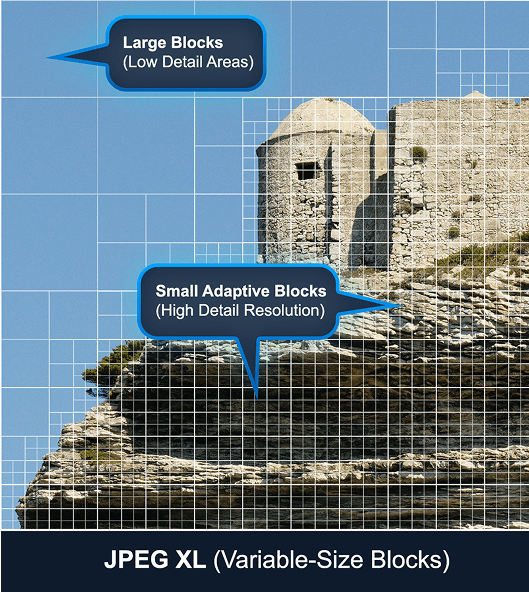
Variable-size transforms — As small as 2x2 and up to 256x256, these allow the encoder to use large, efficient blocks in smooth regions and small, precise ones near edges, adapting to local image content rather than forcing a one-size-fits-all grid.
Perceptually optimized color space — JPEG XL's internal color representation is modeled on the human visual system, enabling smarter allocation of bits to the aspects of the image that matter most to perception.
Advanced entropy coding — Modern and significantly more efficient coding techniques extract more redundancy from the data than legacy approaches could.
Sophisticated prediction and context modeling — The encoder builds a statistical model of the image as it goes, capturing fine-grained local structure and reducing the amount of truly unpredictable information that must be stored.
Native high bit-depth support — unlike legacy JPEG, JPEG XL is designed from the ground up for high bit-depth content, making it an ideal compression layer for RAW imaging pipelines.
We apply JPEG XL with a near-lossless quality setting, meaning the mathematical loss introduced by the codec is negligible — far below the noise floor of any real-world image. The combination with prior DRC is what makes the compression so effective: by removing perceptually irrelevant precision before handing the data to JPEG XL, we give the codec a signal that is inherently easier to compress, without asking it to make any quality-damaging decisions.

For the passionate photographer.